
Running a small business has never been easy.
Twenty-nine years ago, owners were trying to do more with less. They were answering phones, serving customers, putting out fires, and figuring things out as they went.
Sound familiar?
Some things never change.
What has changed is the technology available to help. Today, AI solutions for small business are giving owners new ways to save time, simplify operations, and create better customer experiences.
Back in 1997, VirtualPBX launched the world’s first cloud phone system because we believed there had to be a simpler way for small businesses to communicate.
Twenty-nine years later, we’re still building on that same idea.
At the time, that idea was bigger than just changing the way people made phone calls.
It was about removing a barrier that kept many people from starting businesses in the first place.
Before cloud phones, getting a business phone system meant expensive hardware, complicated installations, and infrastructure that many small businesses simply couldn’t afford.
Lon Baker, VirtualPBX COO, experienced that firsthand.
Before joining VirtualPBX, Lon was one of the company’s earliest customers. In 1997, he and a business partner built a distributed tech support company that relied on VirtualPBX to connect operators across the country.
“We couldn’t have built that business before 1997 because the financials didn’t make sense. We would have had to pay for all of that infrastructure first. Once we had a cloud phone system, we could scale it up or down with how many operators we brought on.”
Cloud technology didn’t just make communication easier.
It made new ideas possible.
And that has been the thread running through VirtualPBX for nearly three decades: using technology to make business more accessible.
Want to hear the full conversation?
Lon Baker, VirtualPBX COO, shares the story behind VirtualPBX’s beginnings, how technology has changed the small business landscape over the last 29 years, and why he believes AI will be the next major shift in how businesses operate. Check it out on YouTube.
Every technology shift solves something. And complicates something else.
Technology has always changed the way we work.
The internet did.
Cloud phones did.
Smartphones did.
Texting did.
Now AI can, too.
But every major advancement comes with a tradeoff.
Smartphones made it possible to answer emails from anywhere, take customer calls on the go, and run a business without being chained to a desk.
They also made it harder to ever truly disconnect.
That’s how technology works.
Every great advancement solves a problem. And it usually creates a few new ones, too.
Lon has watched those shifts happen throughout VirtualPBX’s history.
“The biggest changes were really first when VoIP came along. That was a big transition. You could buy a desk VoIP phone, connect it to your home internet, and suddenly you had a business phone line sitting on your desk.”
But AI represents something different.
Previous technology shifts changed one part of a business.
AI has the potential to touch nearly every part of it.
“The difference with AI is that it’s impacting everything, whether it’s processing data on the back end, building products, or actually doing services for customers on the front end.”
AI Isn’t a Silver Bullet. It’s a Tool.
The conversation around AI has often been one extreme or the other.
It’s either the technology that changes everything overnight, or the technology that replaces everything.
The reality is somewhere in between. And that’s where AI automation for small business becomes valuable.
We don’t think AI is a silver bullet.
It’s another tool.
One that, when used well, can make life a little easier.
Lon believes the biggest mistake companies make with AI is focusing only on what they can replace instead of what they can improve.
“The first phase was this massive overhype where people thought, ‘We’re going to replace our customer service team. We’re going to reduce our engineering team.'"... “But when you take AI down to the individual level, the power it gives people is underappreciated.”
AI’s biggest opportunity may not be removing people from the process.
It may be giving people more capability.
A business owner who has an idea but doesn’t know where to start can ask questions.
A team member can work through problems faster.
A small business can access tools that previously required an entire department.
That’s where AI gets interesting.
Customers Don't Care How You Answer. They Care That You Do.
If you own a small business, you’ve probably answered a customer call while replying to an email.
You’ve probably hoped the phone wouldn’t ring while you were already helping someone else.
Maybe you’ve called a customer back from the parking lot or squeezed in a few emails between appointments.
That’s just part of the job.
The challenge today isn’t a lack of communication tools. It’s that customers expect fast responses with real answers no matter where you are or how busy you are.
That’s why more businesses are looking at AI solutions for small business, small business automation, and customer service automation.
Not because they’re trying to replace great customer service, but because they’re trying to protect it.
In fact, many small businesses are approaching AI the same way. Research from the U.S. Chamber of Commerce shows that businesses are finding practical uses for AI to save time, streamline operations, and improve productivity—not to replace the people who keep their businesses running.
People don’t hate interacting with AI.
They hate bad customer experiences.
A rushed employee can create one.
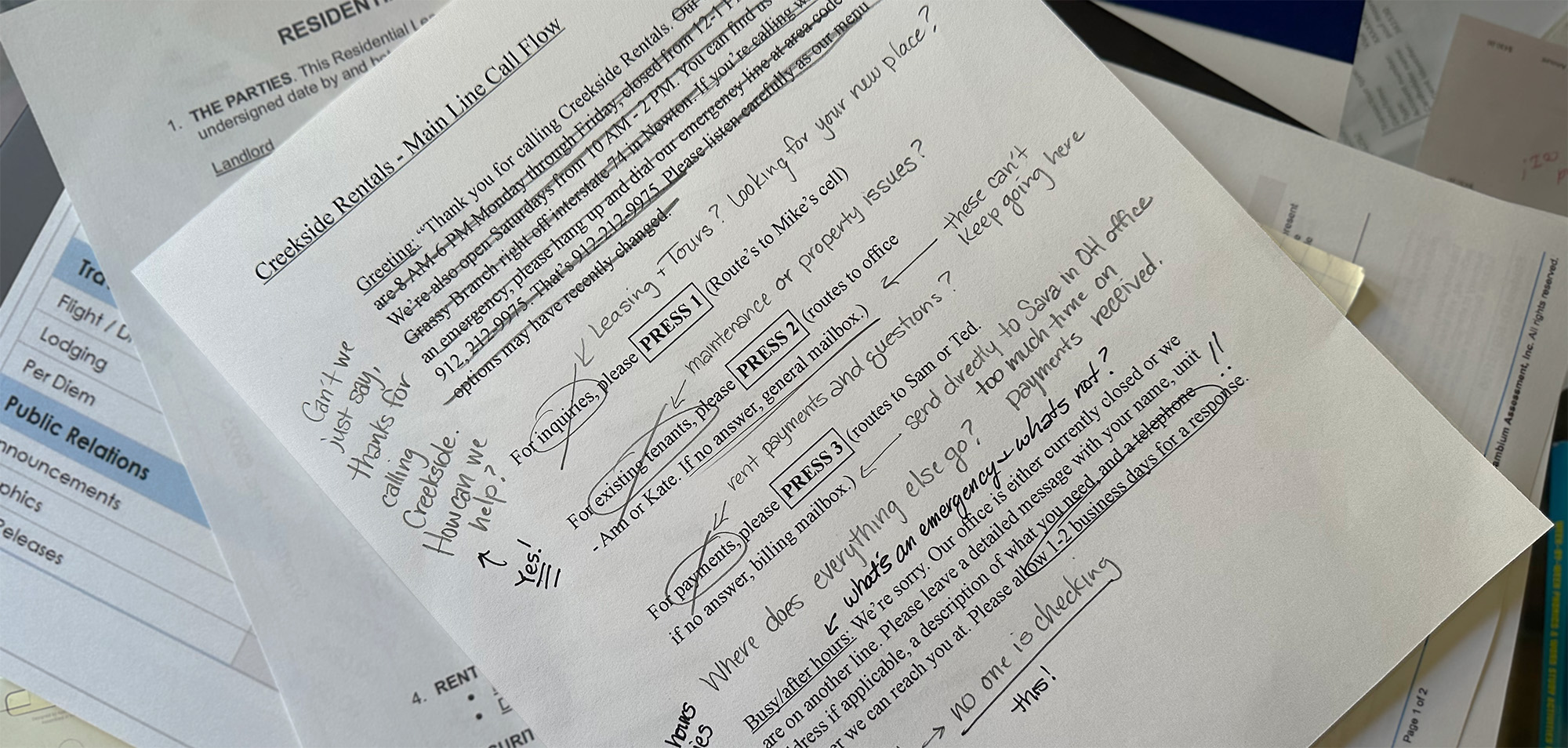
A confusing phone menu can create one.
Poorly implemented AI can create one, too.
The technology isn’t what people remember.
They remember whether you got them the help and answers they needed.
Where AI Employees Fit
AI Employees were built around a simple question:
How do we remove friction from the first interaction a customer has with a business?
For many small businesses, the first person who answers the phone is also the person running appointments, helping customers, managing operations, or doing the actual work their customers came for.
Your AI Employee is a virtual receptionist for small business that answers questions, routes calls, and helps customers get where they need to go without forcing them through phone menus that aren’t always as simple to a customer as they might seem to the business.
But the goal isn’t automation for automation’s sake.
The goal is making communication simpler.
Lon describes the philosophy behind AI Employees this way:
“You reduce the friction for the customer and you compress the complexity. Those are the two things we keep coming back to.”
That means removing unnecessary phone trees. Reducing complicated setup. Making it easier for customers to get answers. And making it easier for small businesses to deliver great experiences.
Why AI EmployeesComes First
When we looked at where AI could make the biggest difference, we didn’t start with the most complicated problem. We looked for the places where small business automation could remove the most friction without creating more complexity.
We started with the first one customers experience. The phone call.
Lon explains:
“The first experience when a caller calls in is the biggest point of friction. If they can’t get to somebody, and it isn’t a pleasant, fast experience, you’re turning away business at your front door.”
That’s why AI Employees aren’t designed to do everything.
Take an AI receptionist for example. It’s designed to do one thing extremely well: be a better first point of contact.
It answers naturally, understands what callers need, and helps route conversations without forcing customers through tons of menus.
Of course, customers don’t call businesses because they want to talk to AI.
They call because they need something.
It doesn’t matter how they get what they need. Only that it’s quick, friendly, and ultimately—helpful.
Celebrating 29 Years by Looking Ahead
Our 29th anniversary isn’t just a chance to look back at where we’ve been. It’s a chance to look at where small businesses are headed next.
For nearly three decades, we’ve watched technology remove barriers that once made running a business harder.
And we believe AI solutions for small business have the potential to continue that work — giving more owners access to tools that were once only available to larger organizations.<
Not by replacing the people behind small businesses.
By giving them more tools, more capability, and more opportunity.
Lon’s hope for the next chapter of VirtualPBX is simple:
“My goal is to bring all the power and talent of our company and our products to any small business owner that wants to start a business — just like I started 29 years ago when I found VirtualPBX the first time.”
That has always been the mission.
Leveling the playing field.
Making powerful technology accessible.
Helping more people bring their ideas to life.
To celebrate our 29th anniversary, we’re making it easier to see what AI Employees can do for yourself.
For a limited time, AI Employees are 50% off for your first three months, bringing the price from $99/month to just $49.50/month.
Because after 29 years, we’ve learned something pretty simple: The best technology isn’t the technology that gets all the attention.
It’s the technology that doesn’t get in the way and helps you do your job a little better tomorrow than you could today.