

I had an AI conversation recently that should have worked.
It sounded human.
It responded quickly.
It almost got everything right.
And it was one of the most frustrating customer experiences I’ve had in a while.
It missed small details that mattered.
It didn’t quite understand what I was asking.
It kept moving forward like it did understand.
And the worst part?
It never told me it was AI.
It left me guessing, feeling like I was going a little crazy.
And it never gave me a way to talk to a real person.
I ended up going into the store to fix it myself.
Here’s the uncomfortable truth:
Bad AI feels fast—but wrong.
Good AI feels helpful—but still human.
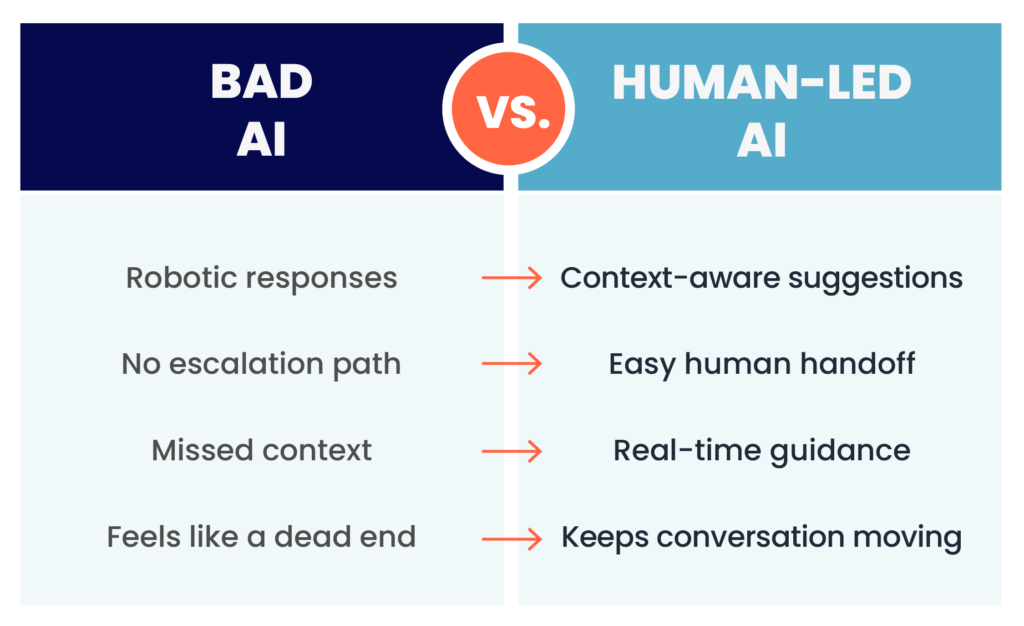
Right now, a lot of businesses are stuck in the first category.
And if you’ve felt that frustration, you’re not alone.
Most customers still prefer interacting with a human, especially when something is complex or going wrong. When AI can’t bridge that gap or hand things off cleanly, it doesn’t just feel inefficient. It feels like a dead end.
The problem isn't all AI
It’s how it’s being used.
A lot of teams—especially the small and growing teams—are under pressure to do more with less. So the instinct is:
- let AI handle everything
- keep it running as long as possible
- only involve a human when absolutely necessary
On paper, that sounds efficient.
In reality, it creates:
- missed nuance
- broken trust
- and customers who feel like they’re talking at something instead of with someone
And that cost is real.
After just one poor customer experience, a large percentage of customers are willing to switch to a competitor. They haven’t really been “wronged,” so they won’t complain. They’ll just feel a bit burned and would rather move on than deal with those experiences on the regular.
What this looks like for real teams
If you’re running a small or mid-sized team, this probably feels familiar:
- You’re in the field and miss a message
- Your team is juggling multiple conversations at once
- A newer employee gives an answer that’s not quite right
- A frustrated customer comes in, and the timing couldn’t be worse
This isn’t a process problem. It’s just operational reality.
And it’s exactly where AI should help, but often doesn’t.
The shift: AI should support the interaction, not own it
The teams getting this right aren’t replacing people.
They’re using AI to protect the human parts of the experience.
A simple way to think about it:
AI handles the pressure. Humans handle the conversation.

What really works
This is what we’re seeing from small and scaling teams using AI in a way that improves customer experience instead of hurting it.

AI absorbs the chaos (so you don’t miss opportunities)
You can’t be everywhere at once.
Whether you’re:
- out on a job
- short-staffed for the day
- or just in the middle of something else
AI can step in to:
- respond quickly
- capture context
- keep the conversation moving
Not to replace you, but to hold things steady until you can jump in.
We see this a lot with teams using tools like VirtualText. It gives them a way to stay responsive without being glued to their phones.

AI helps you prioritize what actually matters
Not every message needs immediate attention.
But some absolutely do.
AI can help surface:
- urgency
- sentiment
- intent
So instead of reacting to everything…
You can focus on what actually moves the day forward.
From a 5-person team to a 30-person one—that shift matters.

AI keeps your responses consistent (even when your team isn’t)
This is one of the most practical benefits—and one of the least talked about.
We’ve seen AI step in mid-conversation to:
- correct outdated pricing
- align messaging with what’s actually on the website
- guide newer team members back on track
Not in a heavy-handed way.
Just enough to keep things consistent.
It’s not about scripting people.
It’s about giving them better footing in real time.

AI supports your team without turning them into scripts
Customers can tell when they’re getting a script.
AI works best when it doesn’t feel like one.
Instead, it can:
- suggest responses based on your actual content
- help refine tone and clarity
- support ESL team members in sounding more natural
The result is still human.
Just more confident, more consistent, and easier to understand.

AI gives your team space to reset
Some conversations take more out of you than others.
AI can:
- step in between interactions
- handle initial replies
- smooth tone when needed
So your team isn’t jumping from one tough conversation straight into the next.
That space matters.
Because how your team feels shows up in how they communicate.

AI helps you catch issues earlier
Most problems don’t start big.
They build.
AI can flag:
- shifts in tone
- repeated frustration
- conversations that are starting to go sideways
So you can step in early—before it turns into a bigger issue.
That kind of visibility is part of how communication platforms like VirtualPBX business phone are evolving—bringing conversations, context, and escalation paths into one place.
Where things break (and trust gets lost)
The biggest issue isn’t that AI makes mistakes.
It’s how those mistakes are handled.
Back to that original experience:
- It tried to pass as human
- It didn’t acknowledge when it was off
- It never gave me a way out
That’s where trust breaks.
If you’re using AI in your customer experience, a few things matter more than anything:
- Be upfront about it
- Don’t trap people in it
- Make it easy to reach a human
Because once someone feels stuck or misled, the damage is already done.
A quick reality check
A missed message at the wrong time doesn’t always feel dramatic in the moment.
But if a customer reaches out while you’re tied up—and doesn’t hear back, or gets a response that doesn’t quite land—they don’t usually wait around.
They just move on.
Not out of frustration. Just because they needed something in that moment.
And that expectation for speed is only getting higher—most customers now expect near-immediate responses, especially in messaging channels.
That’s the gap AI is supposed to close.
The takeaway
Bad implementation is.
For small and growing teams, the opportunity isn’t to automate everything.
It’s to:
- stay responsive without stretching too thin
- keep communication consistent
- and show up better in the moments that matter
A simple way to sanity-check your setup
Ask yourself:
- Does this help us respond faster—or just deflect conversations?
- Can someone easily reach a human when they need to?
- Does this make our team sound better—or more robotic?
- Are we using AI to support decisions—or avoid them?
If the answers feel off, it’s worth a second look.
TL;DR
- AI isn't hurting customer experience on its own, poor implementation is what creates frustration.
- Most customers still want a clear path to a human, especially when issues are complex or emotional.
- For small and mid-sized teams, AI works best when it absorbs workload, not replaces conversation.
- The biggest win for SMBs is not full automation. It's better prioritization, consistency, and response speed.
- "Human-led AI" means AI supports the interaction, while humans stay responsible for the outcome.
Final thought
The goal isn’t to make AI sound human.
It’s to make your humans more effective.
When that’s the focus, AI doesn’t replace the experience.
It quietly makes it better.